|
Tuesday, September 12, 2006
Editorial Suspend the French national anti-doping
lab at Châtenay-Malabry
Sam Sheepdog, Ralph Wolf, and a "L'Equipe-friendly"
anti-doping lab long mired in controversy involving longterm procedural
violations, tampering due to negligence and allegations of favored treatment
for French athletes
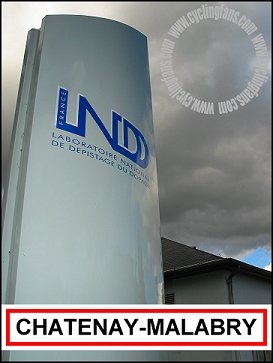
With the Tour's credibility at stake, the Amaury Group, owner then and now of both Amaury Sport Organization* (A.S.O.), organizer of the Tour, and French sports daily L'Equipe, was looking for a new race director for the 1989 edition. That July, in 1988, in the middle of the Tour, Amaury sought out one of its employees, a man by the name of Jean-Marie Leblanc, chief of L'Equipe's cycling pages, for his opinion on candidates for race director. Leblanc quickly identified a Dutchman by the name of Hein Verbruggen, then (and until September, 2005) head of the UCI, as his top candidate to run cycling's biggest race. Verbruggen, in perhaps one of cycling's greatest career non-moves, thanked Leblanc for the consideration but said the Tour should be run by a Frenchman. With the position still vacant, it was Leblanc himself who was named the new director of the Tour de France in October, 1988. Those who have followed professional cycling in recent years, with its very public and ongoing battles fought between A.S.O. and the UCI, will appreciate the irony of Leblanc once suggesting Verbruggen run the Tour de France. Throw World Anti-Doping Agency (WADA) head Dick Pound into the ring and, publicly anyway, more often than not all parties seem to be involved in a gloves-off boxing match. We do hear regularly of "progress" in discussions, of amiable dinners from which new ideas reportedly spring, only to witness more battles whenever the prospect of real change must be faced, change mostly regarding financial matters but usually presented as some supposed anti-doping fight. We are reminded of the Warner Bros. Looney Tunes and Merrie Melodies series of cartoons featuring Sam Sheepdog and Ralph Wolf who, after an amiable "Morning, Ralph" ... "Morning, Sam" chat while punching in for the day's work, proceed to try and beat the crap out of one another. Sam Sheepdog always wins those battles but in cycling no one is winning. Indeed, nearly two months after the end of the 2006 Tour, won by Floyd Landis, no one knows for sure who will ultimately be declared winner for the history books, due to Landis's positive dope sample and the upcoming hearings and appeals. How is it that 18 years after the "Delgado Affair," after which Leblanc took control of the Tour when Verbruggen turned down the opportunity, that the Tour is facing its biggest-ever credibility problem, the same problem Leblanc set out to fix starting in 1989? And why is it that all these parties seem to try to outdo one another in denying Landis his rights as a man accused of doping? At the center of the "Landis Affair," which involves the Tour winner, Landis, giving a urine sample that under the responsibility of the UCI was sent to the WADA-accredited French national anti-doping lab, sits the lab itself, the Laboratoire National de Dépistage du Dopage (LNDD) in Châtenay-Malabry. LNDD is no doubt the most controversial anti-doping lab in the world. Strangely, despite a recommendation from the UCI-commissioned "Vrijman Report," which looked into L'Equipe's doping allegations against Lance Armstrong, that LNDD have its WADA accreditation suspended pending a more thorough investigation, the UCI, publicly anyway, appears to have full confidence in the lab's handling of testing, leaks notwithstanding. Before the Vrijman Report recommended suspending the lab, the Association of Summer Olympic International Federations (ASOIF) and Sergei Bubka, the International Olympic Committee (IOC) athlete's commission chief asked WADA to suspend LNDD for not assuring confidentiality in the re-testing of old urine samples for research purposes in the case known for singling out and specifically targeting Armstrong. Dick Pound refused, then said that he didn't have the authority to suspend the lab's accreditation. And before L'Equipe's Armstrong allegations, and the subsequent finding, by Vrijman, of fault and/or non-cooperation on the part of WADA, LNDD and the French Ministry of Youth and Sport, which funds the lab, there is a history of troubling cases at this same anti-doping laboratory. (See "Past problems at France's national anti-doping laboratory") The cases are as varied as they are troubling, involving longterm procedural violations, suspicious tampering due to negligence and allegations that French athletes have, in one case anyway, been spared dope testing. Throw in evidence, revealed today at cyclingfans.com, that someone at L'Equipe, which works closely with the lab, imagined targeting cycling's biggest star with the goal of taking down the sport, and it is fair to ask, as Armstrong did, "Can this lab be trusted?" LNDD perhaps is staffed by competent lab personnel doing their jobs. But it has long been under political pressure and when, according to investigator Vrijman, LNDD's director, Professor Jacques de Ceaurriz and his top assistant, Dr. Françoise Lasne, came tantalizingly close to talking about some of it, they suddenly shut the door, no doubt due to pressure from the French Ministry of Youth and Sport. There are too many unanswered questions centered on this lab and the answers can only come with the full cooperation of lab personnel, WADA and the French Ministry. But who can secure their cooperation and under what conditions? While Armstrong reportedly is considering going to Congress to put pressure on WADA (which receives funding from governments) and WADA head Pound finds himself facing libel proceedings in Austria due to comments he made about former Austrian ski coach, Walter Mayer, (some cyclists likely will be watching that case closely), in France short of an unlikely French court order it would appear that the only competent authority for ensuring cooperation is the International Olympic Committee (IOC), which created WADA, under threat of Olympic sanctions against French athletes. Only by making it a French national concern can you hope to get cooperation from the government and consequently from the lab. Full transparency with regard to ALL parties is necessary. Failure to cooperate would hurt French Olympic athletes. Such a threat is likely the only tool that could succeed in getting at the truth of the full context of LNDD in present and past doping cases. It is the same tool used by WADA to force international federations, in Olympic sports, to comply with the WADA anti-doping code to begin with. Cycling is the only sport to immediately suspend its athletes simply because they are under investigation. LNDD, and specifically the no doubt difficult political, financial and other pressures it is under, should be investigated. Its staff should be given a chance to speak up without fear of sanction from the French government or WADA. And during this investigation, its WADA accreditation should be suspended. |
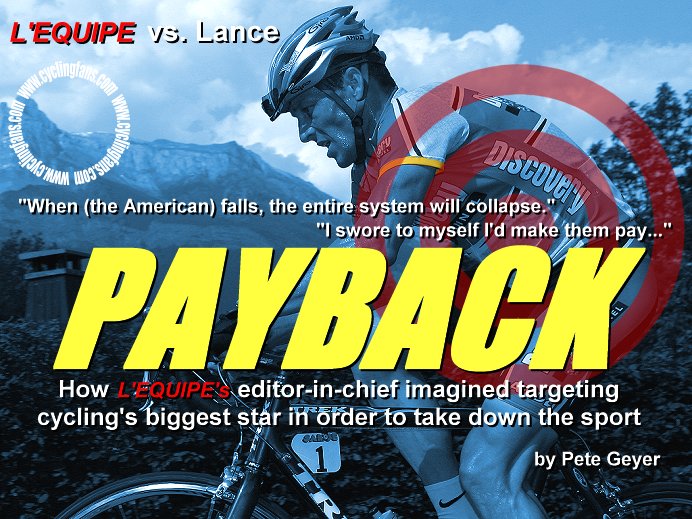
You may have heard of David Walsh and Pierre Ballester , co-authors of the 2004 book, "L.A. Confidentiel: Les secrets de Lance Armstrong". Forget about them. As Armstrong foes, they are cub scouts compared to the man who for years, behind the scenes, rather quietly imagined going after Armstrong and then did just that in 2005. The name of that man may not mean anything to you. It might not mean anything to Armstrong himself. And yet that man, the boss of French sports daily L'Equipe's doping reporter Damien Ressiot is Armstrong's biggest-ever foe, behind no doubt one of the largest propaganda campaigns in the history of sports journalism. In a stunning twist to the story of L'Equipe's pursuit of Armstrong, this mystery man wrote about targeting cycling's biggest star over three years ago with the goal of bringing the sport to its knees. Part I - Part II (coming)
Vuelta: Quick glance at the top 10+ (before Stage 17)
|